
Quiet Leadership: Empowerment Without the Title
Quiet Leadership: Empowerment Without the Title
We’ve all heard the term quiet quitting.
It’s usually framed as disengagement. Withdrawal. Doing the bare minimum.
But what if there’s another quiet movement happening. One that doesn’t shrink back, but steps forward?
What if instead of quiet quitting, we embraced quiet leadership?
Because leadership isn’t reserved for titles.
It isn’t confined to corner offices or nameplates on doors.
It’s about how you choose to show up especially when others aren’t showing up as their best selves.
Leadership Without a Microphone
Quiet leadership is not loud.
It doesn’t demand recognition.
It doesn’t require authority.
It requires integrity.
In Walk Like a Duck, Talk Like a Duck, Lead Like a Duck, we explored how leadership begins with alignment, between what you say, what you expect, and what you do.
Quiet leadership takes that one step further.
It says:
Even if senior management isn’t modeling excellence, I will.
Even if morale is low, I will not let negativity dictate how I show up.
Even if I’m not in charge, I am still responsible for my character.
You may have to follow directions that don’t inspire you.
You may have to work under leaders who are still learning.
But you can still choose to be steady.
And sometimes, that steadiness becomes the quiet example others didn’t know they needed.
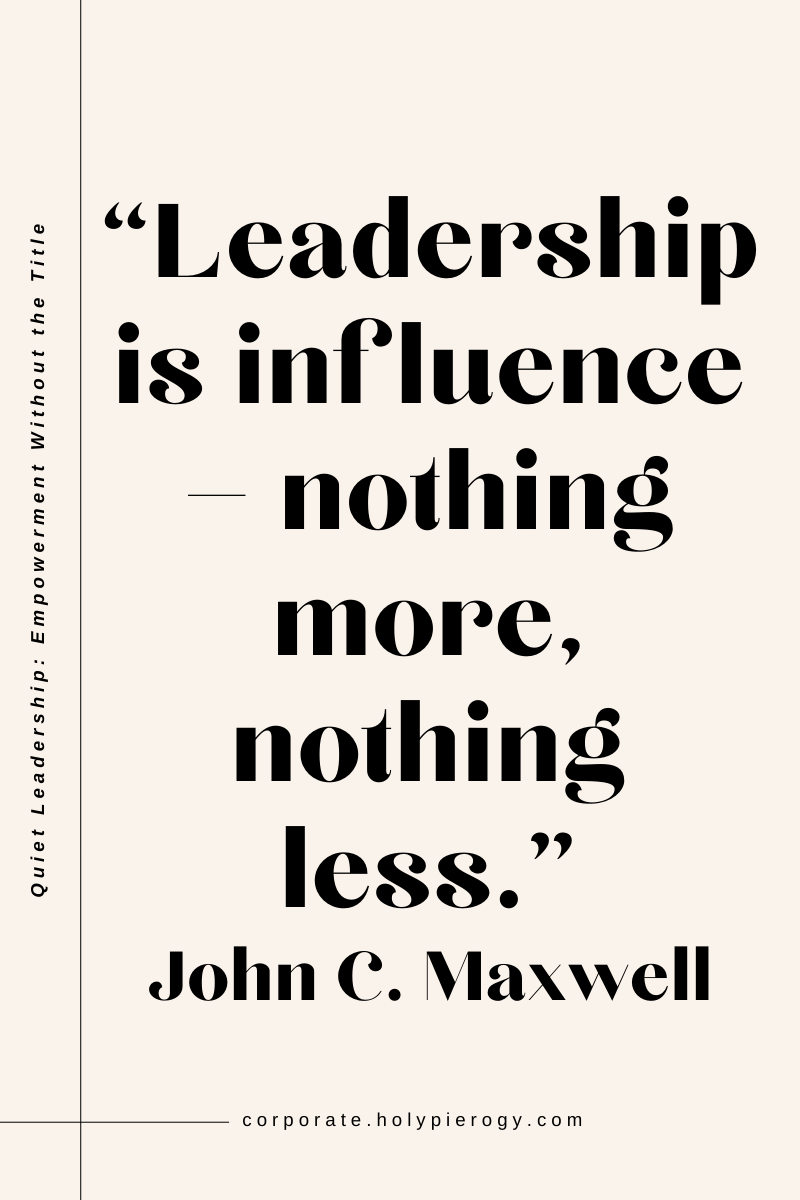
As leadership expert John C. Maxwell reminds us:
“Leadership is influence — nothing more, nothing less.”
Influence doesn’t require volume.
It requires consistency.
A Generational Lens on Quiet Leadership
In The Generational Smackdown, we talked about how every generation brings value and blind spots into the workplace.
Boomers value loyalty.
Gen X values independence.
Millennials value collaboration.
Gen Z values purpose and transparency.
But here’s the common thread:
Every generation responds to respect.
Quiet leadership is often about modeling that respect, especially when tensions rise. It’s about choosing curiosity instead of criticism. It’s about asking, “Did anyone actually explain this?” instead of “Why don’t they just know?”
When you embody patience in a room full of frustration, you shift the temperature.
When you refuse to participate in gossip, you reset the tone.
When you calmly clarify expectations instead of escalating emotions, you create safety.
And safety builds morale.
Three Practical Techniques for Quiet Leadership
Quiet leadership is not passive.
It is intentional.
Here are three ways to practice it daily, regardless of your title.
1. Empower Others as You Would a Friend
The simplest shift?
Treat the people you work with as if they were someone you cared deeply about.
When someone makes a mistake, ask yourself:
If this were a friend or family member, how would I respond?
Would I embarrass them publicly?
Would I assume incompetence?
Or would I offer guidance with dignity?
Empowerment begins with seeing people as human, not just roles.
When you speak to others with respect, even in correction, you elevate the entire atmosphere. You show others what leadership looks like in real time.
And that kind of modeling spreads quietly.
2. Read the Room Before You Lead the Room
Quiet leaders pay attention.
They take the emotional temperature before introducing difficult conversations. They understand that timing matters.
Not everyone likes to be called out in front of others, including you.
Addressing concerns privately, asking questions instead of making accusations, and creating safe spaces for dialogue builds trust.
This echoes a truth we’ve explored before:
Connection is built in questions, not assumptions.
When you read the room, you’re not being cautious, you are being strategic.
And strategy rooted in empathy is powerful.
3. Step Forward When Others Step Back
There are moments in every workplace when something needs to be said but no one wants to say it.
A concern.
A clarification.
A necessary question.
Quiet leadership doesn’t mean silence.
It means speaking up with steadiness rather than ego.
This can feel intimidating if you’re not in management. But a strong, caring voice doesn’t threaten, it invites.
When you model calm communication, others feel safer joining the conversation.
You don’t need to dominate the room.
You simply need to create space within it.
And when multiple voices feel safe to contribute, everyone gains a seat at the table.
Taking It Home
Quiet leadership doesn’t end at the office door.
The way you show up in tension, in misalignment, or in moments of frustration carries into your personal life.
When you practice patience at work, you strengthen it at home.
When you empower others professionally, you model encouragement for your children, your partner, your community.
Empowerment isn’t compartmentalized.
It becomes part of your character.
And here’s the truth:
Negativity is contagious.
But so is steadiness.
When you refuse to let other people’s attitudes dictate your behavior, you break the chain.
Empowerment Is a Choice
You may not control policies.
You may not control senior management.
You may not control decisions made above your pay grade.
But you control how you show up.
You control whether you contribute to morale or diminish it.
You control whether you quietly quit or quietly lead.
Quiet leadership is not about pretending everything is fine.
It’s about choosing integrity over impulse.
As Simon Sinek says:
“Leadership is not about being in charge. It is about taking care of those in your charge.”
And sometimes, “those in your charge” simply means the people standing next to you.
A Final Thought
Quiet leadership may never earn applause.
It may never come with a promotion or recognition.
But it builds something more durable:
Respect.
Trust.
Culture.
And culture shifts not only when policies change but when people do.
So if you’re not in management… lead anyway.
If morale is low… show up anyway.
If others aren’t at their best… choose to be.
Because empowerment doesn’t require permission.
It requires courage and consistency.
And sometimes, the quietest leaders make the strongest impact of all.
Closing Thoughts from the Common Sense Files
Leadership does not always arrive with a title, an office door, or authority over others.
More often, it shows up quietly, in the way someone listens before reacting, offers encouragement when others are frustrated, or chooses integrity even when no one is watching.
Quiet leadership is not about being the loudest voice in the room.
It is about being the most consistent one.
When people choose to show up with patience, curiosity, and respect, even when the environment around them feels difficult, they begin to influence the culture around them in ways they may not immediately see.
A steady example has a way of spreading.
One thoughtful conversation can shift a tense meeting.
One calm response can reset the tone of a difficult moment.
One person choosing integrity can remind others what leadership truly looks like.
Because influence does not require permission.
And leadership, at its core, is less about position and more about the example we choose to set for the people beside us.