Workplace Whodunnit: Who Really Didn’t Explain It?
Workplace Whodunnit: Who Really Didn’t Explain It?
Cue the Dramatic Music…
There’s been a workplace incident.
A new hire missed a deadline.
A seasoned employee skipped a key step.
A supervisor hesitates because they’re not fully sure of the process themselves.
Meanwhile, a manager sighs and says:
“They should all know this by now.”
But the real question remains:
Did anyone ever actually explain the job or expectations clearly?
Welcome to today’s investigation.
Scene 1: The Mystery of “They Should Know This”
We’ve all heard it and if we’re honest, many of us have probably said it.
“I shouldn’t have to explain this again.”
“They’ve been here long enough… they should get it.”
“It’s just common sense.”
But here’s the twist in our workplace mystery:
What we think is obvious often isn’t.
We assume training happened.
We assume expectations were clear.
We assume people know what we mean when we say “do it right.”
But assumptions rarely solve problems.
They simply bury the clues.
In many organizations, expectations live inside people’s heads instead of systems. Over time, those unwritten rules become invisible to the very people expected to follow them.
And when confusion appears, the blame lands on the worker rather than the process.
Scene 2: A Closer Look at the Evidence
Let’s examine what’s really happening behind the scenes.
Many workplaces rely on systems that look organized on paper but struggle in practice:
SOPs that are outdated, overly technical, or rarely revisited
“Sink or swim” onboarding cultures
Managers assuming HR handled training
HR assuming supervisors reinforced the training
ISO or compliance processes focused on checklists instead of understanding
Meanwhile:
New hires may be afraid to ask questions.
Experienced employees may become complacent.
Supervisors may be promoted without being fully trained themselves.
Everyone is passing the torch.
But no one is checking whether the flame is still lit.
And when people don’t speak up, confusion starts to look like carelessness.
That’s when frustration builds.
Morale drops.
Turnover begins.
Scene 3: The Generational Plot Twist
In The Generational Smackdown, we explored how different generations bring different assumptions into the workplace.
Boomers may assume experience equals understanding.
Gen X values independence and figuring things out.
Millennials tend to expect collaboration and feedback.
Gen Z often expects clear systems and transparent communication.
None of these perspectives are wrong.
But when expectations collide without explanation, confusion follows. One generation might see independence as strength. Another might see a lack of guidance as poor leadership.
Without communication, both sides believe the other “should know.”
Scene 4: Questions from the Investigation
Instead of closing the case too quickly, let’s reopen the file and ask better questions.
Could I step into my employee’s role for one day and succeed?
Have I ever actually watched their full process from start to finish?
Do they understand my expectations — or are they guessing?
Who trained them… and how confident was that person in the process?
Are we mentoring people… or simply managing outcomes?
This is where leadership begins to shift.
In Walk Like a Duck, Talk Like a Duck, Lead Like a Duck, we explored how credibility grows when leaders are willing to step into the work themselves.
Not to micromanage. But to understand. Because expectations only make sense when the person setting them understands the path required to meet them.
Mini Quiz: Assumption or Observation?
Let’s test our detective instincts.
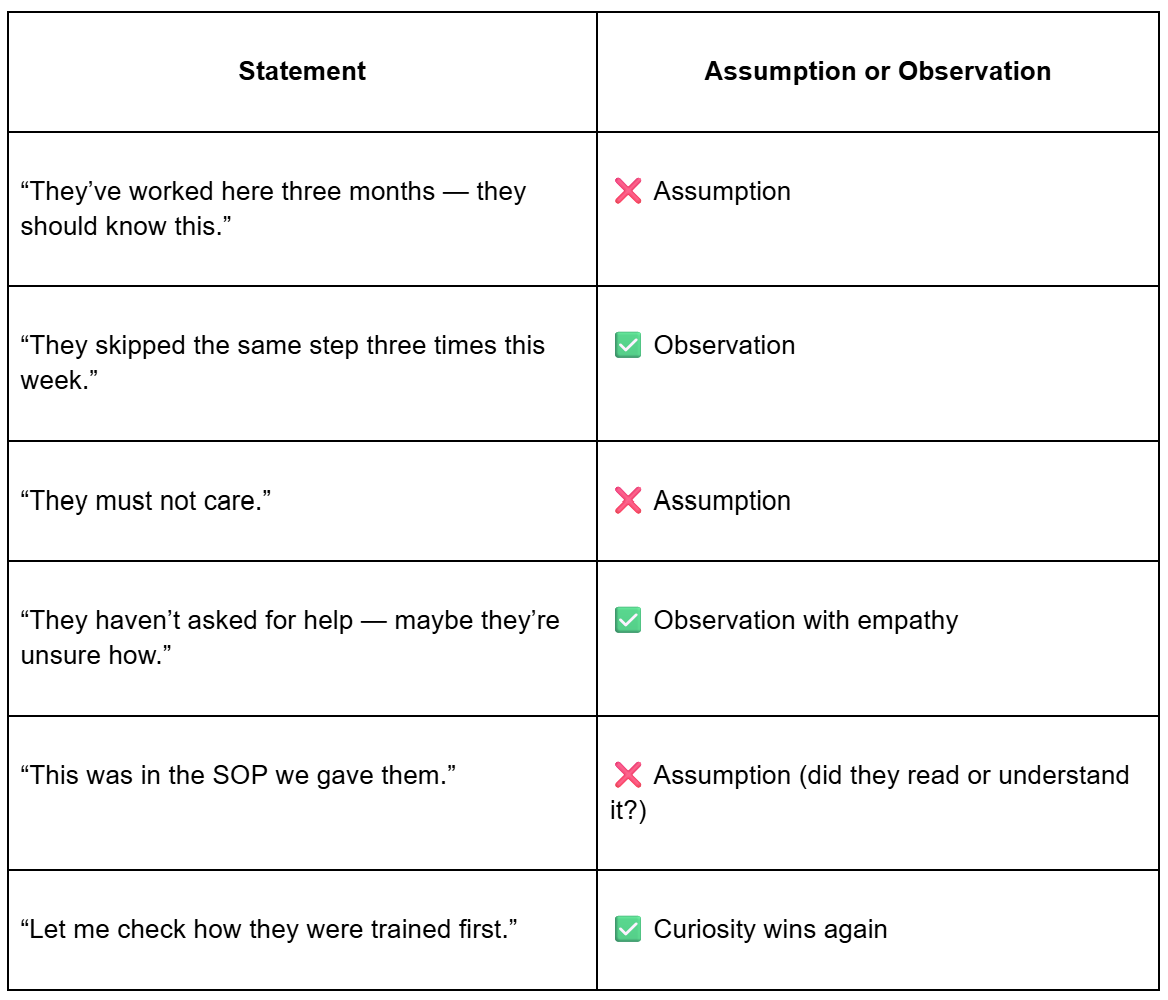
This is where curiosity becomes a leadership skill.
As management thinker Peter Drucker famously said:
“The most important thing in communication is hearing what isn’t said.”
Sometimes the silence in the room tells you more than the mistakes on the report.
Final Scene: Moving from Blame to Building
Here’s the reality:
We can’t undo what wasn’t taught. We can’t go back and re-onboard every employee. We can’t rewrite culture overnight.
But we can shift how we show up from today forward.
We can stop leading for the checkmark. We can build systems that teach, not just track. We can normalize questions instead of punishing them. We can create workplaces where clarity is valued more than pride.
And maybe most importantly…
We can stop assuming everyone “should just know.” Because common sense isn’t actually common.
But empathy? That can be learned.
Closing Thoughts from the Common Sense Files
You’re not a bad manager if your team needs clarity.
You’re not a bad employee if you need something repeated.
You’re not weak for asking questions.
You’re strong enough to say:
“Let’s figure this out together.”
So go ahead.
Solve the mystery.
Not with blame but with curiosity. Because the case of “Why don’t they get it?” was never really about guilt. It was about growth.
And that’s the kind of workplace plot twist we all deserve.